
The brick didn't melt. The mortar didn't fail. The furnace didn't exceed its rated temperature. And yet, three years into the campaign, the hot blast stove dome has visibly deformed, the checker pack is uneven, and the heat distribution has degraded to the point where blast temperature targets can't be reliably met.
This scenario plays out in steel plants often enough that it has a name: creep failure. And it happens specifically because standard high alumina bricks - even first-grade material with Al₂O₃ content above 75% - cannot maintain dimensional stability under sustained mechanical load at temperatures above 1,200°C to 1,300°C. The lining does not collapse dramatically. It moves slowly, invisibly, until the geometry it was supposed to hold no longer exists.
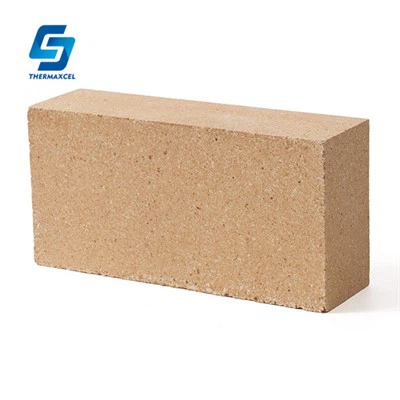
Low creep high alumina brick exists to solve this specific problem. Understanding why requires a clear picture of what creep is, why standard bricks can't avoid it, and how low creep grades are made differently at the microstructural level.

What Creep Actually Does to a Lining
Creep in refractory ceramics is time-dependent deformation under constant stress at elevated temperature. Unlike elastic deformation, which recovers when the load is removed, creep is permanent. The brick shortens by a fraction of a percent every few hundred hours of service, and that fraction accumulates.
In a hot blast stove dome - a structural arch carrying its own dead weight at 1,300°C to 1,400°C - even 0.3% linear creep across the brick courses translates to measurable arch deflection. Joints open on the tension side. The arch loses its geometric efficiency. Hot gas starts finding paths through the lining rather than through the checker pack. Eventually, sections detach.
In a checker chamber, the mechanism is compressive rather than arch-related. Checker bricks at the base of a tall stack carry the weight of every course above them. Standard bricks at 1,200°C under this compressive load compress slowly over years of service. The checker geometry - which determines heat exchange efficiency - distorts. Gas channeling increases. Thermal efficiency drops, and the plant burns more gas to produce the same blast temperature.
The numbers are not academic. Standard first-grade high alumina brick (≥75% Al₂O₃) tested at 1,350°C, 0.2 MPa, 50 hours shows creep rates in the range of 1.0% to 2.0%. Low creep grades at the same test conditions hold this below 0.2%. A hot blast stove campaign runs seven to twelve years. Run the math on compounding deformation at 1.5% versus 0.15% per test cycle and the structural difference at year eight becomes obvious.
Why Standard High Alumina Bricks Cannot Avoid Creep at These Temperatures
The answer lies in the glass phase.
High alumina bricks, regardless of their Al₂O₃ content, contain a residual glass phase in the matrix - the fine-grained binding material between coarser aggregate particles. This glass phase forms during firing from the silica, iron oxides, titanium dioxide, and alkali impurities present in the raw bauxite. At room temperature and moderate furnace temperatures, the glass phase is rigid and performs adequately. But above approximately 1,100°C to 1,200°C, it begins to soften. It doesn't flow visibly or rapidly - but under the continuous mechanical load of an arch or a checker stack, it flows just enough, over enough hours, to produce measurable permanent deformation.
The higher the impurity content in the raw material - particularly Fe₂O₃ and TiO₂, which are naturally present in bauxite - the more glass phase forms during firing, and the earlier that glass phase begins to soften in service. This is why the same nominal Al₂O₃ content can produce bricks with widely different creep behavior depending on the raw material source and firing conditions.
Standard high alumina bricks are not poorly made products. They perform well in most industrial applications. The glass phase is not a defect - it is an inherent result of using bauxite as the primary raw material. The problem is that this glass phase has a thermal limit that standard grades simply cannot exceed without fundamental changes to the microstructure.
How Low Creep High Alumina Bricks Are Made Differently
The approach is called mullite matrix control. The goal is to replace as much of the glass phase in the matrix as possible with mullite - the mineral compound 3Al₂O₃·2SiO₂ - which has a softening resistance several hundred degrees higher than the glass phase it replaces.
Three-stone minerals - andalusite, sillimanite, and kyanite - are the key raw materials that make this possible. All three share the same chemical formula (Al₂SiO₅) but different crystal structures, and all three convert to mullite during firing or in service, releasing free silica in the process:
Al₂SiO₅ → Al₆Si₂O₁₃ (mullite) + SiO₂
By introducing these minerals into the matrix fraction of the batch - carefully controlling the Al₂O₃/SiO₂ ratio toward the theoretical mullite composition - manufacturers drive the matrix to mullitize during firing. The result is a matrix dominated by mullite crystals rather than glass, with the residual glass phase dramatically reduced.
The typical raw material package for a well-made low creep brick includes:
Special-grade bauxite clinker - selected for low impurity content, typically Fe₂O₃ + TiO₂ combined below 2.5%, which directly reduces glass phase formation
Fused corundum - added to the coarse aggregate fraction, providing a high-temperature-stable, essentially glass-free component
Fused or sintered mullite - pre-establishes the target mineral phase in the aggregate
Andalusite, sillimanite, or kyanite - added to the matrix, driving in-service mullitization
High-quality ball clay with low alkali content - as binder, avoiding the introduction of additional flux impurities
The firing temperature matters too. Low creep bricks require firing above 1,500°C to drive mullitization to completion in the matrix. Lower firing temperatures leave unreacted three-stone mineral and residual glass - the brick passes room-temperature physical tests but underperforms in service.
Grade Specifications: What the Numbers Mean
Low creep high alumina bricks are graded primarily by Al₂O₃ content, which governs the temperature range and load conditions each grade can handle. The common designations follow the DRL (Dense Refractory Low-creep) system:
| Grade | Al₂O₃ | Creep Rate (1350°C, 0.2 MPa, 50h) | RUL T₀.₆ | Bulk Density | CCS | Application Zone |
|---|---|---|---|---|---|---|
| DRL-55 | ≥55% | ≤0.5% | ≥1,450°C | ≥2.40 g/cm³ | ≥55 MPa | Lower zones, moderate load |
| DRL-65 | ≥65% | ≤0.4% | ≥1,470°C | ≥2.50 g/cm³ | ≥60 MPa | Hot blast stove walls, blast furnace shaft |
| DRL-75 | ≥75% | ≤0.3% | ≥1,500°C | ≥2.60 g/cm³ | ≥65 MPa | Hot blast stove dome, upper checker |
| DRL-80 | ≥80% | ≤0.2% | ≥1,520°C | ≥2.65 g/cm³ | ≥70 MPa | High-temperature dome, blast furnace high shaft |
Reading the creep rate correctly: A creep rate figure is only valid with its test conditions. "Creep rate ≤0.3%" means nothing without knowing it was measured at 1,350°C, 0.2 MPa load, for 50 hours - the standard reference conditions per YB/T 5016 and similar specifications. A supplier quoting creep at 1,200°C or 20 hours produces numbers that look similar but are not comparable. When requesting specifications, always require the full test conditions alongside the value.
RUL - the companion metric: Refractoriness Under Load (T₀.₆) measures the temperature at which a brick under 0.2 MPa compressive load deforms by 0.6%. This indicates the practical upper temperature limit for load-bearing applications - more useful for arch and dome design than the nominal Al₂O₃ content.
Where Low Creep Bricks Are Required
Hot Blast Stoves - The Primary Application
Hot blast stoves (Cowper stoves) were the application that drove low creep brick development. They preheat the air blast supplied to blast furnaces, cycling between combustion (heating) and blast delivery (cooling) continuously over campaigns measured in years.
The dome operates at the highest temperature in the stove - commonly 1,300°C to 1,400°C - and functions as a structural arch supporting significant dead weight. The upper checker chamber, where incoming gas is at its hottest, runs between 1,100°C and 1,350°C depending on stove design. Both zones require sustained dimensional stability that standard high alumina bricks cannot provide.
Typical zone specifications for a modern hot blast stove:
Dome and upper vault: DRL-75 or DRL-80 - highest temperature, maximum structural requirement
Upper checker chamber (>1,100°C): DRL-65 to DRL-75 depending on operating temperature
Lower checker chamber: DRL-55 or standard high alumina - temperature is lower, creep requirement is less stringent
Combustion chamber walls: DRL-65, depending on design temperature
Replacing a hot blast stove dome is a week-scale shutdown event for a blast furnace - production loss during that period dwarfs the cost difference between standard and low creep bricks. The economics of correct specification are not subtle.
Blast Furnace Shaft
The blast furnace shaft operates under combined mechanical load from the burden above and chemical attack from CO gas and alkalis. The upper and middle shaft zones, at 700°C to 1,200°C, benefit from low creep bricks because the combination of sustained compressive load and chemical attack accelerates degradation of glass-phase-rich standard bricks. DRL-65 is the common specification here.
Coke Ovens
Coke oven flue walls and regenerator zones operate continuously at 1,100°C to 1,350°C for decades without shutdown. If the flue walls bow or compress, the coking chamber narrows, coking times increase, and mechanical pushing of coke becomes problematic. Low creep brick in flue walls prevents this progressive geometric degradation.
Glass Furnace Regenerators
The upper zones of glass furnace regenerators, where temperatures exceed 1,200°C, use low creep high alumina brick in the checker packing. Maintaining the geometry of the checker pack over multi-year glass furnace campaigns requires the dimensional stability that standard grades cannot guarantee at these temperatures.
When Standard High Alumina Brick Is Still the Right Choice
Not every high-temperature application needs low creep bricks. The specification is warranted when three conditions exist simultaneously:
Sustained mechanical load - the brick is under continuous compressive stress, not intermittent. Arch structures, dome linings, tall checker stacks, and shaft linings qualify. Floor linings in batch kilns typically do not.
Sustained temperature above 1,200°C - below this threshold, the glass phase in standard bricks does not soften enough to produce meaningful creep. The specification only becomes critical as temperatures push into 1,200°C–1,400°C and above.
Long campaign life - a lining designed to run for twelve months can tolerate more total creep than one expected to last ten years. Low creep bricks add meaningful value when campaign life targets make cumulative deformation a structural concern.
If any of these three conditions is absent - the load is light, the temperature is below 1,200°C, or the campaign is short - standard high alumina brick at the appropriate grade is often the better economic decision. Over-specifying a lining adds cost without adding longevity.
Low Creep High Alumina vs. Silica Brick: Choosing Between Them
For hot blast stove applications above 1,350°C, buyers often compare low creep high alumina bricks against silica bricks. Both are legitimate solutions, and the choice comes down to operating conditions and constraints.
Low creep high alumina brick handles temperature fluctuations. It can be cooled and reheated without the risk of thermal shock cracking that silica brick carries. For stoves that experience unplanned shutdowns, temperature swings during operational changes, or any scenario requiring flexibility in the heating and cooling schedule, low creep high alumina is the operationally safer choice.
Silica brick has a higher RUL - often exceeding 1,650°C - and essentially zero creep under load above 600°C due to the stable tridymite and cristobalite phases that form during firing. For stoves operating continuously above 1,400°C without cycling or shutdown, silica brick offers superior long-term dimensional stability. The constraint is that silica brick must never cool below approximately 600°C - the crystalline phase changes below this temperature cause destructive volume expansion. Any unplanned shutdown that drops the stove below this threshold risks catastrophic lining damage.
The practical guidance: modern large-capacity hot blast stoves running continuously above 1,400°C with minimal shutdown risk use silica brick in the dome and upper vault. Stoves in the 1,300°C to 1,400°C range, or stoves where operational flexibility is valued, use low creep high alumina brick.
Five Things to Check Before Ordering
1. Require the full creep test conditions, not just the rate Temperature, load, and duration must all be stated. The standard reference - 1,350°C, 0.2 MPa, 50 hours - is what to request for hot blast stove dome applications. Anything measured under softer conditions is not directly comparable.
2. Ask for the impurity analysis Fe₂O₃ and TiO₂ content directly influence how much glass phase forms during firing. Combined impurities above 3% in the finished brick indicate a lower-purity raw material source, which will typically show higher creep at temperature even if the Al₂O₃ content meets specification.
3. Confirm firing temperature in production Low creep brick requires firing above 1,500°C to complete mullitization of the matrix. Bricks fired at lower temperatures may pass room-temperature physical tests while carrying a significant unreacted glass phase that only becomes evident as creep in service.
4. Check apparent porosity alongside density Low creep bricks should have apparent porosity below 20% - typically 17–19% for DRL-65 and DRL-75. Higher porosity means more open pathways for alkali vapor penetration in service, which attacks the mullite phase and accelerates the same degradation the brick was selected to resist.
5. Verify dimensional tolerances for arch and dome applications In load-bearing arch installations, tolerance on brick dimensions - especially wedge bricks - should be within ±1 mm on height and width. Variable joint widths in an arch cause uneven load distribution under thermal expansion, concentrating stress at narrow joints and opening gaps at wide ones. The brick grade matters; so does the dimensional consistency of the production batch.