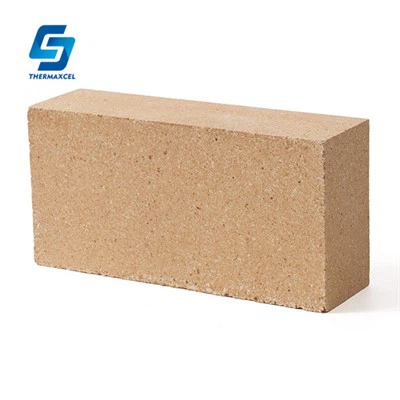
The operating conditions of high alumina bricks in electric furnace roofs are extremely harsh. The maximum operating temperature reaches 1650°C. Especially during the reduction period, the bricks are exposed to high temperatures for extended periods. After tapping and repairing the furnace, the temperature drops to 1350°C. During top-loading, the furnace roof is exposed to the atmosphere and rapidly cools to below 800°C. In addition to the impact of high temperatures and sudden temperature changes, the high-alumina bricks in the roofs are also corroded by oxides such as CaO and MgO introduced by slag-forming and repair materials, and FeO in the furnace dust. This causes multiple destructive stresses. The extent of these damages depends on the brick's physical and chemical properties, high temperature, and mechanical resistance, as well as the smelting operations and the construction of the high-alumina refractory bricks in the roofs..

1. Thermal spalling
Rapid temperature swings during charging, arc flare, and subsequent cooling create steep thermal gradients inside the high alumina bricks. The material's inherent low thermal conductivity traps heat at the hot face, generating tensile stresses that open micro-cracks. After only a few cycles these cracks link up, causing spalls that expose the steel shell.
Remedy: Specify phosphate-bonded or spinel-enriched high alumina refractory bricks whose improved thermal-shock resistance cuts spalling frequency by up to 35 %. Install flexible ceramic fiber blankets behind the working lining to act as a compliant layer that absorbs differential expansion.
2. Chemical attack by FeO-rich slag
At 1 650 °C the FeO content of EAF slag aggressively dissolves mullite and corundum grains in conventional high alumina firebricks, forming low-melting fayalite and hercynite. Progressive slag penetration weakens the matrix and leads to catastrophic washouts above the fourth hole area.
Remedy: Transition to a two-layer design. Use a 90 % dense high alumina refractory brick on the hot face and back it with a magnesia-carbon safety lining. The magnesia layer acts as a sacrificial barrier that slows FeO diffusion. Additionally, optimize slag chemistry (MgO saturation > 8 %) to reduce its aggressiveness.
3. Mechanical impact and vibration
Heavy scrap drops, electrode swings and CO-burst explosions impose mechanical loads far beyond the cold-crushing strength of standard high alumina brick. Resulting edge chipping accelerates lining loss around the delta section.
Remedy: Introduce a monolithic precast delta made of low-cement, high-alumina castable reinforced with stainless needles. The monolith distributes impact loads more uniformly, extending service life by two campaigns or more.
4. Oxidation-reduction cycling
During power-off periods the roof atmosphere becomes highly reducing (high CO), then switches back to oxidizing when oxygen lancing resumes. This redox cycling reduces Fe₂O₃ impurities in the high alumina brick to metallic iron, causing a 3 % volume expansion that loosens bricks and opens joints.
Remedy: Specify high-purity, low-iron high aluminum brick (Fe₂O₃ < 1 %) and seal joints with high-temperature mortar containing SiC antioxidants. A slight positive furnace pressure further minimizes CO ingress.
5. Structural deflection
Long spans and inadequate water-cooling allow the roof ring to sag, creating tensile stress at the crown. Bricks work loose, hot gas bypasses the lining, and local overheating follows.
Remedy: Retrofit the roof with an integrated water-cooling channel system and use suspended arch construction. Cooling keeps the steel shell below 250 °C, preserving the mechanical integrity of both shell and high alumina refractory brick.
Based on damage analysis of high alumina bricks used in electric furnace roofs, improving the quality of high-alumina bricks is crucial to extending the life of the roof. This involves producing high-purity, high-density, and crack-resistant bricks. Furthermore, based on current trends in refractory bricks, the roof refractory material can be manufactured as prefabricated, unfired blocks using chrome corundum castables. This eliminates the mortar joints and erosion stress associated with high-alumina bricks.